East Bengal 1–0 Al Hussein: Lachenpa’s Heroics and Jeakson’s Late Strike Keep ACL Two Dream Alive
East Bengal overcame sustained pressure from Al Hussein to register a historic 1–0 victory in the AFC Champions League Two. Phurba Lachenpa produced eight saves before Jeakson Singh struck in the 87th minute, keeping the Indian club's knockout qualification hopes alive.
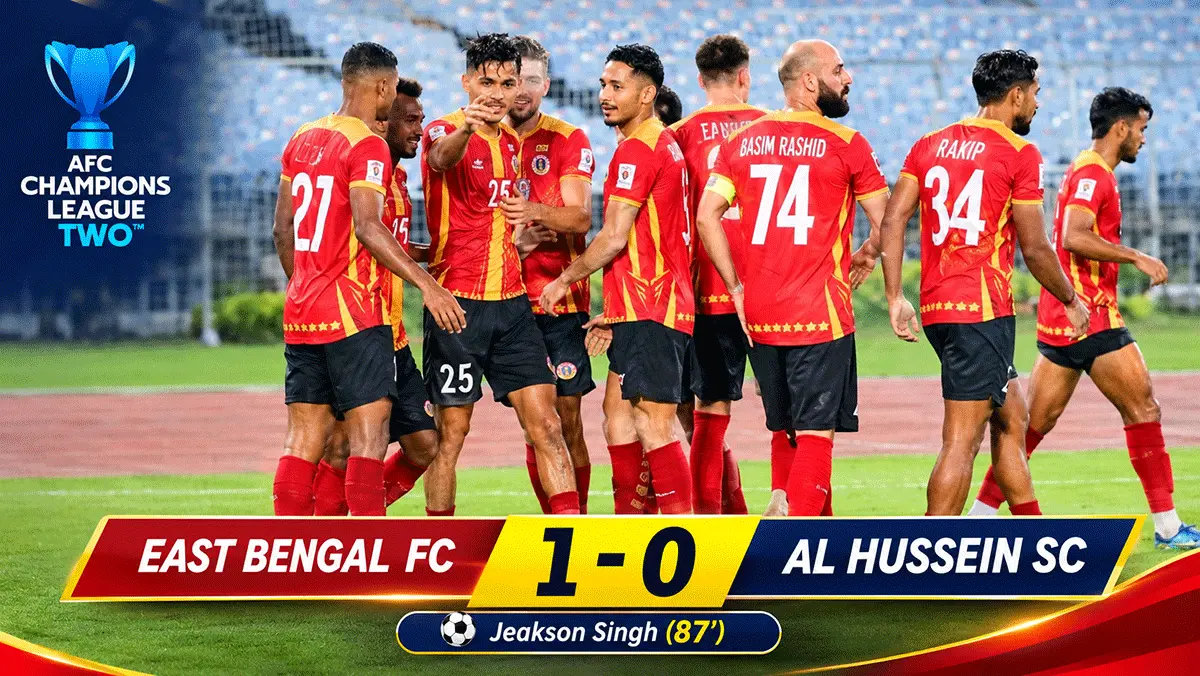
Twenty-nine attempts, eight shots on target and 12 corners. Al Hussein produced enough attacking opportunities to threaten East Bengal throughout Tuesday’s AFC Champions League Two encounter, yet it was the Indian club that emerged with all three points.
East Bengal 1–0 Al Hussein was a result built on defensive resistance, exceptional goalkeeping and one decisive moment of attacking intelligence. Jeakson Singh scored in the 87th minute following an inventive assist from David Lalhlansanga, securing a historic victory for Antonio López Habas’ side at the Vivekananda Yuba Bharati Krirangan in Kolkata on November 24, 2026.
The result represented the first victory by an Indian club since the continental competition was rebranded as the AFC Champions League Two in 2024–25. More immediately, it ensured that East Bengal would enter their final Group D fixture against Al Shorta with a mathematical chance of reaching the knockout rounds.
East Bengal 1–0 Al Hussein: Match Summary
| Match information | Details |
|---|---|
| Competition | AFC Champions League Two 2026–27 |
| Stage | Group D, Matchday 5 |
| Date | November 24, 2026 |
| Venue | Vivekananda Yuba Bharati Krirangan, Kolkata |
| Half-time | 0–0 |
| Full-time | East Bengal FC 1–0 Al Hussein SC |
| Goalscorer | Jeakson Singh (87′) |
| Assist | David Lalhlansanga |
| East Bengal head coach | Antonio López Habas |
| Al Hussein head coach | Curro Torres |
East Bengal entered the fixture with two points from four matches and no victories in the competition. Their opening meeting with Al Hussein had finished 2–2 in Jordan, making Tuesday’s victory particularly valuable in the head-to-head record between the clubs.
Al Hussein’s Attacking Superiority Fails to Produce a First-Half Goal
The visitors began the contest with clear attacking intent. Al Hussein were comfortable circulating possession and moving the ball into advanced areas. Mahmoud Al Mardi and Aref Al Haj posed early problems for the home defence, while Mohamed Rayhi provided another attacking threat. The Jordanian side’s most promising early opportunity exposed the limitations of East Bengal’s defensive structure.
Al Haj broke through and rounded Phurba Lachenpa but failed to capitalise on the open goal. East Bengal also threatened through Chris Ikonomidis and David Lalhlansanga, although neither managed to convert their opportunities.
Lachenpa Keeps East Bengal in Contention
The home goalkeeper became increasingly influential as Al Hussein established attacking momentum. His first-half interventions included an outstanding save from Rayhi’s long-range attempt. Al Hussein also threatened directly from a corner, with the ball striking the outside of the post. East Bengal’s ability to reach half-time without conceding was significant.
For a team that needed a positive result, remaining level ensured that the match could still be decided by a single successful attacking move. However, the volume of chances created by Al Hussein suggested that East Bengal would need either greater control after the interval or another exceptional defensive effort.
Second-Half Woodwork Drama Maintains the Deadlock
The opening stages of the second half provided opportunities at both ends. Al Haj struck the upright in the 49th minute, before Dani Ramírez came close to putting East Bengal ahead through an effort that also hit the woodwork. Al Haj was denied by the crossbar shortly afterwards. Yousef Qashi subsequently hit the post with a long-range attempt, adding to the visitors’ growing frustration.
The sequence demonstrated how fine the margins remained despite Al Hussein’s territorial advantage. East Bengal were struggling to prevent the visitors from creating opportunities, but the Jordanian side’s finishing repeatedly failed to match the quality of its approach play.
Habas Refreshes His Attacking Options
East Bengal made three substitutions before the 70th minute. Bipin Singh replaced Chris Ikonomidis at half-time, Vishnu PV came on for Dani Ramírez in the 63rd minute, and Łukasz Zwoliński replaced Aké Loba four minutes later. These changes introduced fresh attacking personnel while the contest remained goalless. The decisive contribution, however, would eventually come from two players who had started the match.
The Decisive Moment: David’s Creativity and Jeakson’s Composure
With three minutes of regulation time remaining, East Bengal found the breakthrough. A corner created an opening inside the Al Hussein penalty area. David Lalhlansanga recognised Jeakson Singh’s position and used a clever backheel to direct the ball towards the midfielder. Jeakson controlled the pass before firing beyond Mahmoud Al Kawamleh. The execution was important, but so too was the speed of thought behind the assist.
Rather than attempting a difficult individual finish, David identified an opportunity to create a better shooting position for his teammate. Jeakson’s goal rewarded East Bengal’s persistence and transformed the contest in its closing stages. It also gave the club their first continental victory of the season after four unsuccessful attempts.
East Bengal vs Al Hussein: Full Match Statistics
The numerical contrast between the two teams makes East Bengal’s result particularly remarkable.
| Statistic | East Bengal | Al Hussein |
|---|---|---|
| Possession | 37% | 63% |
| Total shots | 10 | 29 |
| Shots on target | 3 | 8 |
| Shots off target | 5 | 12 |
| Blocked shots | 2 | 9 |
| Shots inside the box | 6 | 11 |
| Shots outside the box | 4 | 18 |
| Corners | 3 | 12 |
| Total passes | 307 | 534 |
| Accurate passes | 227 | 465 |
| Passing accuracy | 74% | 87% |
| Goalkeeper saves | 8 | 2 |
| Fouls | 10 | 11 |
| Yellow cards | 1 | 2 |
| Offsides | 1 | 1 |
Statistics are based on published match data.
Al Hussein attempted almost three times as many shots as East Bengal and completed substantially more passes. Nevertheless, the visitors failed to convert any of their eight attempts on target. East Bengal, by contrast, needed only three shots on target to produce the winning goal.
The statistics do not suggest that East Bengal controlled the match. They instead illustrate how goalkeeping, finishing efficiency and decisive interventions can outweigh superiority in possession and attacking volume.
Tactical Analysis: How East Bengal Survived Al Hussein’s Pressure
A defensive approach that delivered a result but carried risks
East Bengal’s starting personnel have been listed in a 3-4-1-2 formation by published lineup providers. Diego Živulić, Sandip Mandi and Lalchungnunga supplied the defensive foundation, with Jeakson Singh and Mohammed Rashid providing central midfield support. The system offered numerical protection in defensive areas, but Al Hussein still found considerable attacking freedom.
The visitors’ 29 attempts and 12 corners indicate that East Bengal did not fully restrict access to dangerous positions. A clean sheet was achieved, but the underlying performance suggests that greater defensive control remains necessary.
The importance of shot location
One interesting aspect of Al Hussein’s attacking display was the number of attempts from outside the penalty area. Eighteen of their 29 shots came from distance. Although some of those efforts were dangerous, particularly the attempts that struck the woodwork, the high volume of long-range shooting did not translate into goals.
East Bengal’s defence also blocked nine attempts. Those interventions reduced the number of shots that reached Lachenpa, although the goalkeeper was still required to make eight saves.
Making set-piece situations count
Al Hussein earned four times as many corners as their opponents. However, it was East Bengal who scored from a situation created by a corner. This was another example of the difference between generating opportunities and maximising their value. East Bengal’s winning move depended on quick decision-making inside a congested penalty area rather than a straightforward aerial finish.
Habas’ immediate priority was achieved
With qualification hopes under threat, East Bengal needed a result that would keep them in contention. From that perspective, Habas achieved his primary objective. The performance was not one of sustained attacking control, and the defensive risks cannot be ignored. However, the home side remained competitive long enough to capitalise on a late opportunity. For the coaching staff, the key challenge will be retaining that resilience while reducing the number of chances conceded in future matches.
Phurba Lachenpa: The Standout Performer Behind East Bengal’s Clean Sheet
Although Jeakson Singh delivered the winning goal, Lachenpa’s contribution was fundamental to the outcome. The goalkeeper recorded eight saves and prevented Al Hussein from scoring despite sustained pressure. His performance required several different goalkeeping qualities:
- Quick reactions against powerful shots.
- Effective positioning to reduce shooting angles.
- Concentration during repeated attacking sequences.
- Composure when the opposition continued to threaten late in the match.
East Bengal’s inability to control possession meant that the goalkeeper had limited opportunities to relax throughout the contest. From an editorial perspective, Lachenpa was the standout performer because his interventions preserved the conditions in which one goal could decide the result. That assessment is separate from any official Player of the Match award. His clean sheet was also an encouraging response to East Bengal’s recent defensive difficulties in domestic competition.
Jeakson Singh and David Lalhlansanga Deliver on the Continental Stage
The identity of East Bengal’s match-winning combination adds another dimension to the result. Jeakson is generally associated with midfield organisation, defensive support and ball distribution rather than regular goal scoring. His movement into a dangerous position and subsequent finish demonstrated the importance of contributions from players outside the recognised forward line. David’s assist was equally valuable. The forward remained involved late in the game and demonstrated awareness under pressure by creating the decisive shooting opportunity.
For Indian clubs competing internationally, contributions from domestic footballers are essential. Foreign players can provide experience and technical quality, but performances such as those from Lachenpa, Jeakson and David demonstrate the importance of Indian players assuming responsibility in decisive continental moments.
Confirmed Starting Lineups
East Bengal FC
Phurba Lachenpa; Sandip Mandi, Diego Živulić, Lalchungnunga, Jay Gupta, Jeakson Singh, Mohammed Rashid, Dani Ramírez, Chris Ikonomidis, David Lalhlansanga and Aké Loba.
Substitutes used: Bipin Singh, Vishnu PV, Łukasz Zwoliński and Asif Khan.
Head coach: Antonio López Habas.
Al Hussein SC
Mahmoud Al Kawamleh; Pedro Henrique, Abdallah Nasib, Ahmad Assaf, Adham Al Quraishi, Mahmoud Shawkat, Yousef Qashi, Moamen Al Sakhet, Aref Al Haj, Mohamed Rayhi and Mahmoud Al Mardi.
Head coach: Curro Torres.
Why This Victory Matters for Indian Club Football
East Bengal’s achievement extends beyond their own group-stage campaign. According to the All India Football Federation, this was the first win by an Indian club in the AFC Champions League Two since its rebranding in 2024–25. The competition occupies an important position within the current Asian club football structure.
Success at this level requires Indian teams to compete against opponents with different tactical approaches, established international players and considerable continental experience. East Bengal’s victory does not erase the challenges Indian clubs face in Asia. Nor does it establish that the gap between Indian football and stronger continental opponents has disappeared. However, it provides a meaningful competitive milestone.
For players and coaches, winning such fixtures can offer valuable experience in managing pressure, exploiting limited opportunities and adapting to unfamiliar opponents. For supporters, it represents a welcome achievement on a stage beyond domestic competition.
AFC Champions League Two Group D: Qualification Battle Remains Open
East Bengal initially moved into second place following their victory over Al Hussein. However, the group’s other Matchday 5 fixture changed the standings later in the evening. Al Seeb defeated already-qualified Al Shorta 2–0, taking the Omani club to seven points. East Bengal consequently face a more complicated qualification scenario heading into the final round.
Group D standings after Matchday 5
| Position | Club | P | W | D | L | GF | GA | GD | Pts |
|---|---|---|---|---|---|---|---|---|---|
| 1 | Al Shorta | 5 | 3 | 1 | 1 | 8 | 5 | +3 | 10 |
| 2 | Al Seeb | 5 | 2 | 1 | 2 | 4 | 4 | 0 | 7 |
| 3 | East Bengal | 5 | 1 | 2 | 2 | 5 | 7 | -2 | 5 |
| 4 | Al Hussein | 5 | 1 | 2 | 2 | 6 | 7 | -1 | 5 |
East Bengal hold the head-to-head advantage over Al Hussein, having drawn in Jordan and won in Kolkata. Al Shorta have already qualified, leaving the other three clubs competing for the remaining knockout berth.
East Bengal’s group-stage campaign so far
| Date | Opponent | Venue | Result |
|---|---|---|---|
| September 16 | Al Hussein | Away | 2–2 draw |
| October 13 | Al Shorta | Home | 2–3 defeat |
| October 27 | Al Seeb | Away | 0–0 draw |
| November 3 | Al Seeb | Home | 0–2 defeat |
| November 24 | Al Hussein | Home | 1–0 win |
Exactly What East Bengal Need to Reach the Round of 16
Both remaining Group D fixtures are scheduled for December 8. East Bengal will travel to Baghdad to face Al Shorta, while Al Hussein will host Al Seeb in Amman. Habas’ side must win their final fixture to reach eight points. However, an East Bengal victory alone will not guarantee qualification.
| Al Hussein vs Al Seeb result | Implication if East Bengal win |
|---|---|
| Al Hussein win | East Bengal qualify through their superior head-to-head record against Al Hussein |
| Draw | Al Seeb qualify through their superior head-to-head record against East Bengal |
| Al Seeb win | Al Seeb qualify with 10 points |
East Bengal’s path therefore requires two results: an away victory against Al Shorta and an Al Hussein victory over Al Seeb. The irony is that the club East Bengal defeated on Tuesday must now help them on the final matchday.
The Kolkata Derby Presents a Different Challenge
Before travelling to Iraq, East Bengal are scheduled to face Mohun Bagan Super Giant in the Indian Super League on November 29. Tuesday’s continental success provides an important psychological boost, but the tactical demands of the derby will be different. East Bengal will need to improve their ability to retain possession and prevent opponents from creating repeated attacking opportunities. Allowing another 29 attempts against a strong domestic rival would place significant pressure on their defensive organisation.
The clean sheet against Al Hussein should therefore be viewed as both an achievement and an opportunity for the coaching staff to identify areas requiring improvement. The most encouraging aspect for Habas is that his team has demonstrated the ability to remain competitive in difficult circumstances and produce a winning moment late in a match.
East Bengal’s Next AFC Champions League Two Fixture
| Fixture details | Information |
|---|---|
| Opponent | Al Shorta SC |
| Date | December 8, 2026 |
| Kick-off | 9:30 PM IST |
| Venue | Al-Zawraa Stadium, Baghdad, Iraq |
| Stage | Group D, Matchday 6 |
East Bengal suffered a narrow 3–2 defeat when the clubs met in Kolkata earlier in the campaign. The return fixture will require an away victory against a team that has already secured qualification. Habas and his players must approach that match knowing that only three points can preserve their chances.
Conclusion: A Historic Result Built on Resilience Rather Than Dominance
East Bengal’s 1–0 victory over Al Hussein was not a performance defined by possession or territorial superiority. It was a victory achieved through resistance, an outstanding goalkeeping display and clinical execution when the decisive opportunity arrived.
Lachenpa kept his team in the contest. David supplied an inventive assist. Jeakson delivered the finish that secured three points and a place in the competition’s history for Indian football. The result also ensured that East Bengal’s continental campaign remains alive heading into the final group fixture.
Qualification is still dependent on results elsewhere, while the performance against Al Hussein exposed areas that require improvement. Nevertheless, the achievement deserves recognition. For East Bengal, November 24 was the night a difficult continental campaign finally produced its first victory. For Indian club football, it was a significant milestone in the AFC Champions League Two era.
Follow the competition: AFC Champions League Two News and Updates — MaidanCharcha
Indian football coverage: Latest News, Match Reports and Analysis
Related Stories