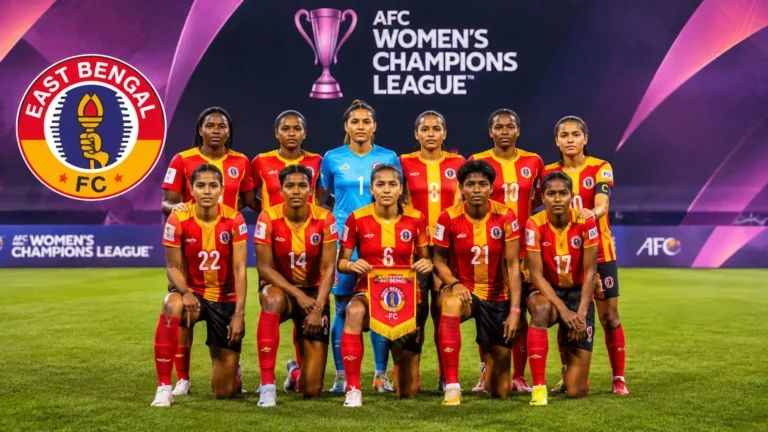
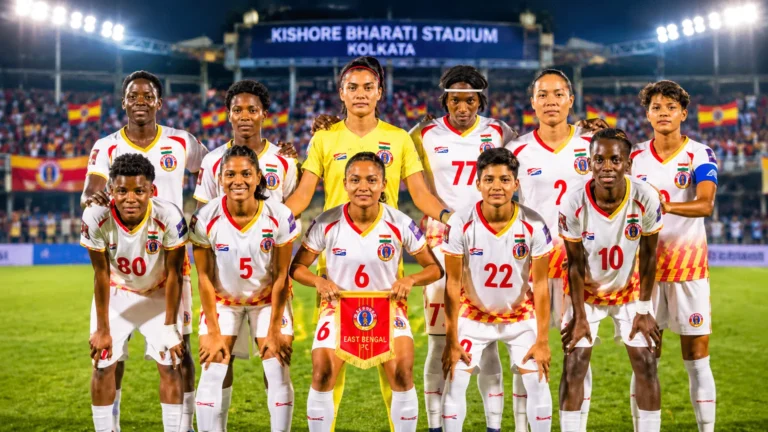
History in Kolkata: East Bengal Bring AFC Women’s Champions League to India for the First Time
East Bengal FC bring the AFC Women's Champions League to India for the first time as Kolkata hosts Group B from November 1–7, 2026. The Moshal Girls, led by Anthony Andrews, aim for a historic quarter-final berth against top Asian clubs.
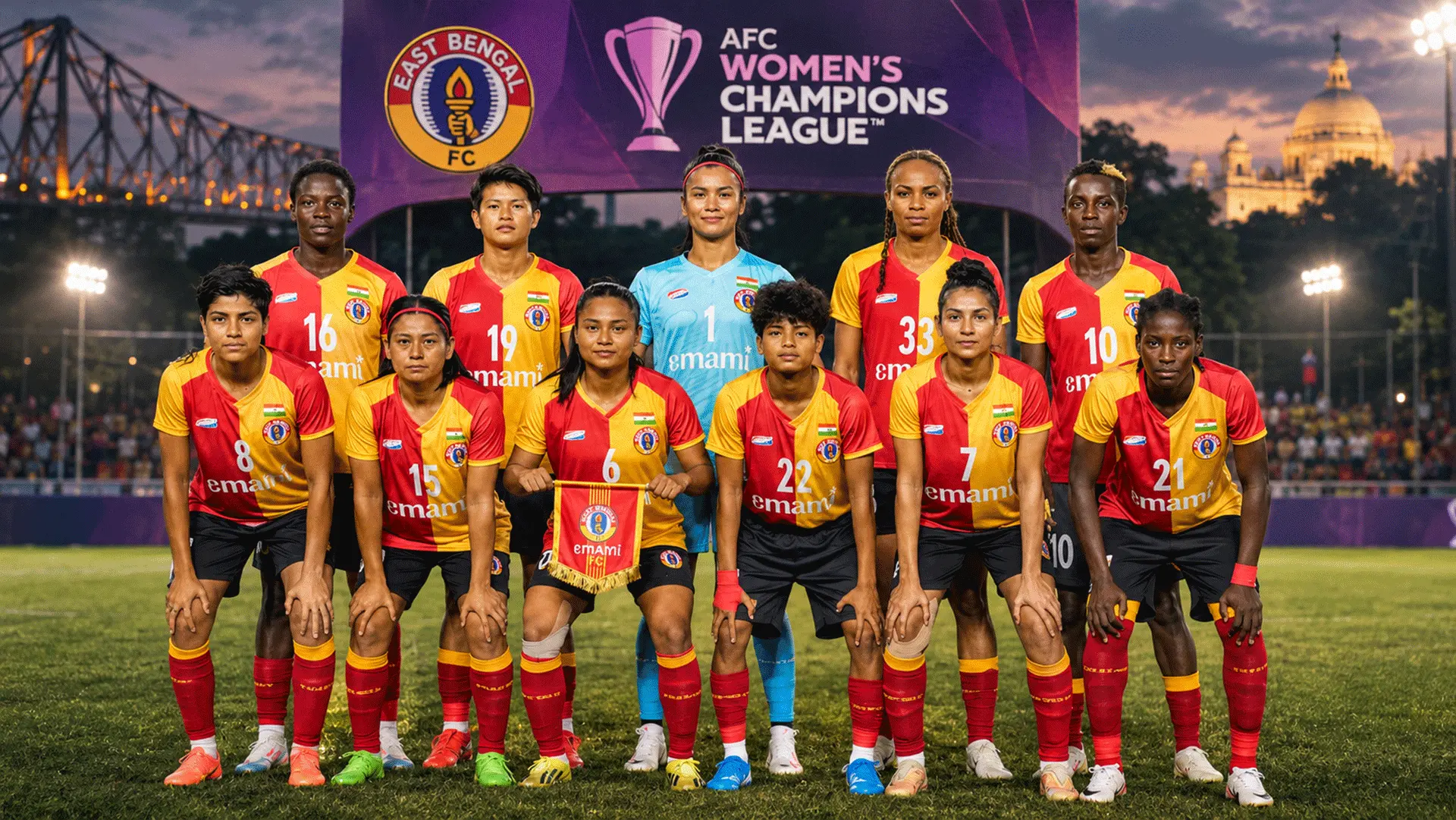
Maidan Charcha | November 1, 2026 | Kolkata
Indian women’s football is preparing to witness a landmark occasion. For the first time in history, India will host matches of the AFC Women’s Champions League, Asia’s premier women’s club football competition. And at the centre of this historic development stands one of the country’s oldest and most celebrated football institutions — East Bengal FC.
From November 1 to November 7, Kolkata’s Kishore Bharati Krirangan will become a stage for elite women’s club football, welcoming teams from Vietnam, South Korea and North Korea.
The tournament’s arrival in India is not merely another international sporting event. It represents a significant step forward for women’s football in the country, highlighting the growing ambitions of Indian clubs and the progress being made in developing the women’s game.
For East Bengal, affectionately known as the Red and Gold Brigade, the occasion carries enormous pride. The club’s women’s team, popularly called the Moshal Girls, have earned the opportunity to compete against some of Asia’s strongest sides while representing Indian football on home soil. And this time, their ambitions extend beyond participation.
East Bengal want to become the first Indian club to reach the AFC Women’s Champions League quarter-finals.
A Historic First for Indian Women’s Club Football
The AFC Women’s Champions League is the Asian Football Confederation’s flagship continental competition for women’s clubs. The 2026–27 season marks the third edition of the tournament, bringing together 12 clubs from across Asia.
The group stage is being played across three centralised venues: Kolkata in India, Yangon in Myanmar and Qarshi in Uzbekistan.
India’s selection as a host nation represents an important milestone. Although Indian women’s football has participated in international competitions for decades, the opportunity to stage the continent’s leading women’s club tournament offers a new level of exposure.
For Kolkata, a city renowned for its passionate football culture, the occasion is particularly meaningful. The city has witnessed countless historic football encounters involving East Bengal, Mohun Bagan and other prominent clubs. Now, it has the opportunity to establish itself as a destination for international women’s club football as well.
East Bengal’s role as the host club makes the achievement even more significant. The Red and Gold Brigade are not simply participating in an overseas tournament. They are helping bring continental women’s football directly to Indian supporters.
Why East Bengal Deserve This Historic Opportunity
East Bengal’s presence in the competition is the result of sustained progress rather than a fortunate invitation. The club’s women’s team have established themselves as a major force in domestic football, winning the Indian Women’s League and building an increasingly competitive squad. Their success has also extended beyond India’s borders.
In August 2026, East Bengal travelled to Kota Kinabalu, Malaysia, for the AFC Women’s Champions League preliminary stage. They were placed in Group A alongside Sabah FA of Malaysia, Rovers FC of Guam and Rajshahi Stars FC of Bangladesh.
The Moshal Girls delivered an outstanding campaign. They defeated Rajshahi Stars 4–0, overwhelmed Rovers FC 12–0 and completed their group fixtures with a 2–0 victory over hosts Sabah FA. Three matches. Three victories. Eighteen goals scored. None conceded.
It was a dominant performance that secured East Bengal’s place in the group stage for the second consecutive season. The achievement also demonstrated the team’s growing confidence on the international stage. Having narrowly missed out on the knockout rounds in their previous campaign, East Bengal now have another opportunity to take the next step. This time, they will have the advantage of playing in front of their own supporters.
The Moshal Girls: A Team Growing in Confidence
Under head coach Anthony Andrews, East Bengal’s women’s team have developed a reputation for disciplined football, attacking efficiency and collective determination. Their recent international record underlines that progress. Ahead of the group stage, East Bengal have remained unbeaten in eight consecutive international matches, scoring 34 goals without conceding.
That impressive sequence includes their triumph in the inaugural SAFF Women’s Club Championship in Kathmandu. Such results have strengthened the team’s belief that they can compete beyond domestic football. However, the AFC Women’s Champions League group stage represents a considerable step up in quality.
East Bengal will face established champions from three different Asian footballing nations. The matches will test their defensive organisation, physical fitness, tactical discipline and ability to convert opportunities against stronger opposition. For Andrews and his players, the challenge is significant. But it is precisely the kind of challenge that ambitious Indian women’s clubs must embrace to improve.
East Bengal’s Group B: Three Formidable Opponents
The September 3 draw placed East Bengal in Group B alongside three accomplished clubs. Each opponent brings a different footballing tradition and considerable competitive experience.
Ho Chi Minh City WFC — Vietnam
East Bengal begin their campaign against Vietnamese champions Ho Chi Minh City WFC on November 1. The Vietnamese club are among the most established names in their country’s women’s football. They also possess valuable experience in the AFC Women’s Champions League, having reached the semi-finals in the competition’s inaugural edition and the quarter-finals in the following season.
That experience makes them dangerous opponents. For East Bengal, the opening fixture will be crucial. A positive result would provide confidence ahead of two equally demanding matches. However, the Moshal Girls cannot afford to underestimate the quality and organisation of the Vietnamese champions.
Hwacheon KSPO WFC — South Korea
East Bengal’s second opponents are Hwacheon KSPO WFC, the 2025 WK League champions. South Korean women’s football is known for its technical development, tactical structure and disciplined approach. Hwacheon’s domestic success makes them one of the strongest contenders in Group B.
Their meeting with East Bengal on November 4 could play a decisive role in determining the group’s qualification picture. The Indian side will need to remain compact defensively while making the most of opportunities in transition.
4.25 SC — North Korea
East Bengal conclude their group-stage campaign against North Korea’s 4.25 SC on November 7. The club are champions of the DPR Korea Women’s Premier League. North Korean women’s football has a strong international tradition, particularly in youth competitions.
Facing 4.25 SC will therefore represent another demanding examination for East Bengal. Depending on the results of the opening two matches, the final fixture could have major implications for qualification. For the Moshal Girls, maintaining concentration across all three games will be essential.
AFC Women’s Champions League 2026–27: East Bengal Fixtures
| Date | Fixture | Venue |
|---|---|---|
| November 1 | Ho Chi Minh City WFC vs East Bengal FC | Kishore Bharati Krirangan, Kolkata |
| November 4 | East Bengal FC vs Hwacheon KSPO WFC | Kishore Bharati Krirangan, Kolkata |
| November 7 | East Bengal FC vs 4.25 SC | Kishore Bharati Krirangan, Kolkata |
East Bengal’s opening match against Ho Chi Minh City is scheduled for 8:00 PM IST on November 1.
The fixture will be available to watch in India through FanCode.
Anthony Andrews and the Challenge of Continental Football
East Bengal’s progress under Anthony Andrews has been one of the encouraging developments in Indian women’s club football. The coach has overseen a team that combines attacking ambition with defensive discipline. Their unbeaten international run suggests a squad capable of controlling matches and maintaining concentration. However, Andrews knows that the group stage will demand a higher level of performance.
Speaking ahead of the tournament, the coach acknowledged the significance of competing on home soil and expressed confidence in his team’s preparation.
East Bengal have worked on adapting to the pace and physical intensity expected from continental opponents. Their preparations have included matches against boys’ youth teams, designed to expose the players to faster and more demanding situations. Such preparation could prove valuable against opponents from Vietnam, South Korea and North Korea.
The coach will also have to manage the pressure of expectation. Playing at home offers an advantage, but it also brings the responsibility of performing in front of supporters eager to witness another historic achievement.
Foreign Recruits and Indian Talent Strengthen East Bengal
East Bengal have assembled a squad that combines experienced foreign footballers with promising Indian talent. Among their attacking options, Ugandan forward Fazila Ikwaput offers valuable international experience. The squad has also been strengthened by Japanese footballer Hitomi Tanaka and Ghanaian players Olivia Anokye, Adama Alhassan and Abigail Antwi.
Indian internationals Rimpa Haldar and Thoibisana Chanu have added further depth. Olivia Anokye was particularly influential during the preliminary stage, scoring five goals as East Bengal secured qualification. Her attacking movement and finishing could be important against the stronger defensive units awaiting the Moshal Girls in Group B.
However, the team’s prospects cannot depend on individual performances alone. East Bengal will need contributions across the pitch. Defensive organisation, midfield discipline and intelligent attacking combinations will be essential if they are to compete effectively. The presence of foreign players alongside Indian footballers also creates an opportunity for knowledge-sharing and development within the squad. For younger Indian players, competing against established Asian clubs offers invaluable experience.
How Can East Bengal Reach the Quarter-Finals?
The AFC Women’s Champions League 2026–27 features 12 clubs divided into three groups of four. Each team plays its three group opponents once. Eight clubs will progress to the quarter-finals.
The qualification system allows the following teams to advance:
- All three group winners.
- All three group runners-up.
- The two best third-placed teams across the three groups.
This format means that finishing third does not automatically end a team’s campaign. However, every point and goal could become important when the final standings are calculated. For East Bengal, securing a positive result against Ho Chi Minh City would provide an excellent foundation.
Their subsequent matches against Hwacheon KSPO and 4.25 SC will demand equally strong performances. The quarter-finals are scheduled for March 2027, with the draw expected in December 2026. Qualifying for the last eight would be a landmark achievement for the club and for Indian women’s football.
Why Hosting the Tournament Matters Beyond East Bengal
The significance of the AFC Women’s Champions League coming to India extends far beyond one football club. Women’s football in India has made progress, but considerable challenges remain. Domestic competitions require greater visibility, improved infrastructure, stronger commercial support and more consistent opportunities for players. Hosting a major continental competition can help address some of those challenges.
Greater visibility for women’s football
International club matches provide an opportunity to attract supporters who may not regularly follow the women’s domestic game. The presence of established Asian teams can introduce new audiences to the quality and competitiveness of women’s football.
Inspiration for young footballers
For young girls aspiring to become professional footballers, watching international women’s club football in their own city can be a powerful experience. Seeing Indian players compete against foreign champions demonstrates that continental football is an achievable ambition.
Exposure to higher competitive standards
Matches against clubs from established footballing nations allow Indian players and coaches to assess their progress. They also highlight areas requiring improvement, from tactical organisation to fitness and technical execution.
An opportunity for Kolkata’s football culture
Kolkata’s football identity has historically been shaped by passionate club rivalries and enormous supporter involvement. The AFC Women’s Champions League offers the city an opportunity to extend that passion to women’s football. A strong turnout at Kishore Bharati Krirangan would send an encouraging message about the future of the women’s game.
East Bengal’s Responsibility as Hosts
East Bengal’s role in bringing the competition to India deserves recognition. Hosting international women’s club football requires more than providing a venue. It involves organisational preparation, coordination with football authorities, matchday arrangements and the responsibility of representing Indian football before an international audience.
The successful staging of the tournament could strengthen India’s case for hosting similar competitions in the future. For East Bengal, it also offers an opportunity to demonstrate that the club’s ambitions extend beyond its men’s team. The development of a successful women’s football programme can become an important part of the institution’s long-term identity.
The Red and Gold Brigade have already shown their commitment through domestic success and repeated continental qualification. Now they have an opportunity to build on that progress before their home supporters.
Can the Moshal Girls Make History Again?
East Bengal enter the group stage with confidence, but the road ahead is difficult. Their opponents possess domestic titles, international experience and strong footballing traditions. The Moshal Girls must therefore approach every fixture with discipline and determination.
The opening match against Ho Chi Minh City could establish the tone for the entire campaign. A victory would significantly improve East Bengal’s confidence and qualification prospects. Even a competitive performance against the Vietnamese champions would offer encouragement ahead of the remaining fixtures. But East Bengal’s ultimate ambition is clear.
Having qualified for the group stage in consecutive seasons, they now want to go further. Reaching the quarter-finals would represent another major breakthrough.
Maidan Charcha Analysis: A Historic Moment Indian Football Must Embrace
November 1, 2026, deserves a special place in the history of Indian women’s club football. For the first time, the AFC Women’s Champions League group stage is being staged in India, with East Bengal FC playing a central role in bringing the competition to Kolkata. This achievement is important regardless of how the results unfold over the next seven days.
The Moshal Girls have already demonstrated their progress by winning domestic honours, competing successfully in South Asia and qualifying for the continental group stage for a second consecutive season. But the opportunity now is much greater.
East Bengal can show that Indian women’s clubs are capable of competing with stronger teams from across Asia. They can inspire young footballers, attract new supporters and help bring women’s football into the mainstream sporting conversation.
For Kolkata, the occasion is another reminder of the city’s enduring relationship with football. For East Bengal, it is an opportunity to add a remarkable new chapter to the club’s history. And for Indian women’s football, it could mark the beginning of something much bigger.
Maidan Charcha’s Verdict: East Bengal have already made history by helping bring the AFC Women’s Champions League to India. Now the challenge is to make that historic opportunity count on the pitch. A quarter-final appearance would be an extraordinary achievement, but the tournament’s arrival in Kolkata is itself a victory for the growth and visibility of Indian women’s football.
The stage is ready. The Moshal Girls are ready. And for the first time, Asia’s premier women’s club football competition has arrived in India — courtesy of East Bengal FC.
Related Stories