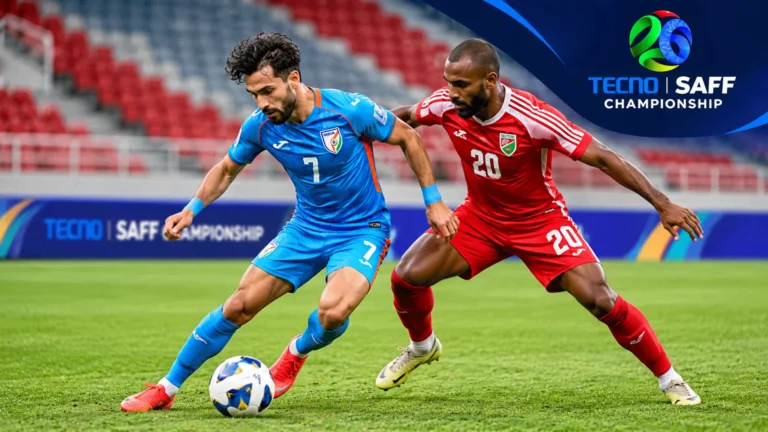
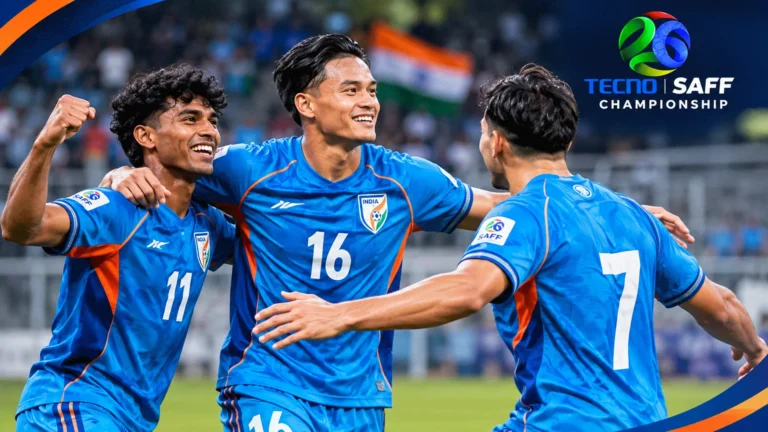
India Beat Pakistan 2-1 to Win SAFF Championship 2026: Sandip Mandi’s Late Header Seals Historic 10th Title
India are SAFF champions for the 10th time! Sandip Mandi's dramatic 88th-minute header completed a 2-1 comeback victory over Pakistan in Dhaka, securing the Blue Tigers' third consecutive title.
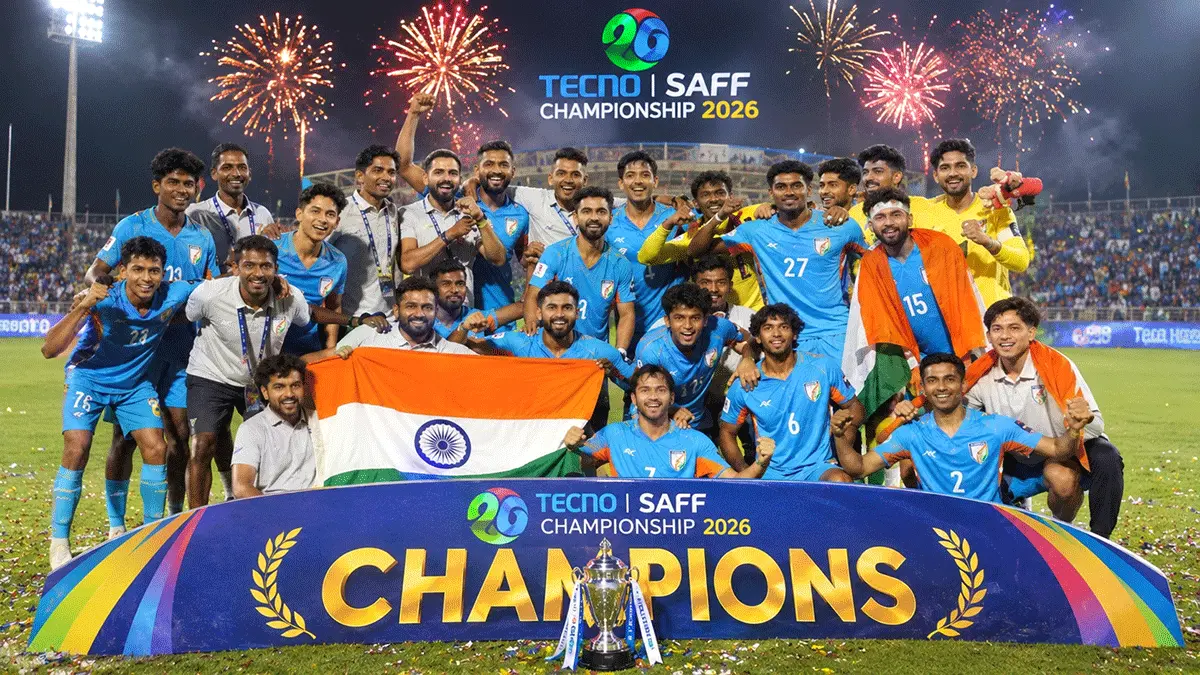
India are the kings of South Asian football once again. A dramatic 88th-minute header from defender Sandip Mandi completed a remarkable comeback as the Blue Tigers defeated Pakistan 2-1 in the SAFF Championship 2026 final at the National Stadium in Dhaka on Tuesday, November 17. The victory secured India’s record-extending 10th SAFF Championship title and marked the first time the country has won three consecutive editions of the tournament.
For much of the first half, the final appeared to be slipping away from Naushad Moosa’s side. Pakistan dominated the opening exchanges, created several opportunities and eventually took the lead through Alamgir Ghazi in first-half stoppage time. However, the second half produced a completely different story.
A red card for Pakistan defender Junaid Shah in the 59th minute changed the balance of the contest. Suhail Ahmad Bhat equalised almost immediately before Sandip Mandi delivered the decisive moment with just two minutes of regulation time remaining.
The final whistle sparked celebrations among India’s players and coaching staff as the Blue Tigers added another chapter to their remarkable SAFF Championship history.
India vs Pakistan SAFF Championship 2026 Final: Match Summary
| Match Details | Information |
|---|---|
| Competition | SAFF Championship 2026 |
| Match | India vs Pakistan |
| Date | November 17, 2026 |
| Venue | National Stadium, Dhaka, Bangladesh |
| Final Score | India 2-1 Pakistan |
| Half-Time Score | India 0-1 Pakistan |
| India Goals | Suhail Ahmad Bhat (60′), Sandip Mandi (88′) |
| Pakistan Goal | Alamgir Ghazi (45+1′) |
| Red Card | Junaid Shah, Pakistan (59′) |
| India Head Coach | Naushad Moosa |
| India Captain | Chinglensana Singh Konsham |
| Champions | India |
| SAFF Titles | 10 |
Pakistan Dominate the Opening Stages of the Final
India entered the final as defending champions, but Pakistan made the more convincing start. Naushad Moosa retained the same starting eleven that had defeated Bhutan in the semi-final, hoping continuity would help India establish control. Instead, Pakistan’s aggressive approach caused immediate problems. Their players pressed India’s midfield, moved the ball quickly into wide areas and repeatedly threatened the penalty box.
India struggled to maintain possession for extended periods and found it difficult to build attacks from the back. Pakistan’s attacking movement frequently forced Indian defenders into hurried clearances. In the 17th minute, goalkeeper Arsh Anwer Shaikh was drawn towards the edge of his penalty area, creating an opportunity for Muhammad Ali Khan to threaten the exposed goal. India’s covering defence prevented the situation from becoming a goal.
Moments later, McKeal Abdullah produced an acrobatic attempt from close range, but Shaikh reacted quickly to deny him. The Indian goalkeeper remained busy as Pakistan continued to create dangerous opportunities.
India Struggle to Find Their Attacking Rhythm
India’s attacking players found little space during the opening half-hour. Suhail Ahmad Bhat attempted to capitalise on an uncertain back pass before later cutting inside from the left and shooting over the crossbar. However, Pakistan’s defensive organisation made it difficult for India to establish a consistent attacking pattern. The midfield struggled to connect with the forwards, while Pakistan’s pressure frequently disrupted India’s passing.
After the cooling break, the Blue Tigers began showing signs of improvement. They enjoyed better spells of possession and forced Pakistan goalkeeper Yousuf Butt into an important save from a powerful effort outside the penalty area. For a brief period, India appeared capable of taking control. But Pakistan struck at the worst possible moment for the defending champions.
Alamgir Ghazi Gives Pakistan the Lead Before Half-Time
The breakthrough arrived in the first minute of first-half stoppage time. Junaid Shah delivered a dangerous low ball from the left flank. The delivery took a deflection off Indian defender Khaiminthang Lhungdim before reaching Alamgir Ghazi inside the penalty area. Ghazi controlled the ball and produced an excellent right-footed curling finish into the far corner. Arsh Anwer Shaikh could do little to prevent the goal. Pakistan had taken a deserved 1-0 lead.
The goal rewarded their positive first-half performance and left India facing a difficult challenge. For Pakistan, appearing in their first SAFF Championship final, the possibility of winning a historic maiden title suddenly appeared much closer. India entered the interval trailing by one goal, knowing that a significant improvement was required.
Naushad Moosa’s Half-Time Change Transforms India’s Midfield
India head coach Naushad Moosa responded immediately. At half-time, he replaced Manglenthang Kipgen with Macarton Nickson. The substitution proved important. Nickson brought greater energy and directness to India’s midfield, helping the Blue Tigers move the ball forward more effectively.
India began attacking with greater urgency and looked increasingly comfortable in possession. In the 51st minute, Nickson drove through the middle before releasing Vishnu PV on the left. Vishnu fired towards goal, but his attempt struck Pakistan goalkeeper Yousuf Butt and then the post.
India had come agonisingly close to an equaliser. Although Pakistan still led, the momentum was beginning to shift. Moosa’s tactical adjustment had improved India’s attacking structure, and the defending champions were finally asking serious questions of Pakistan’s defence.
Junaid Shah Sent Off After VAR Review: The Turning Point
The most significant moment of the final arrived in the 59th minute. Pakistan’s Junaid Shah made a dangerous studs-up challenge on Indian midfielder Brison Fernandes. The incident initially went unpunished, but the Video Assistant Referee intervened. After reviewing the challenge on the pitchside monitor, the referee showed Shah a straight red card.
Pakistan were reduced to ten players. The decision dramatically changed the match. Having controlled much of the first half, Pakistan now faced the challenge of protecting their narrow lead with a numerical disadvantage. India immediately increased the pressure. And within a minute, the Blue Tigers were level.
Suhail Ahmad Bhat Equalises in the 60th Minute
India’s equaliser arrived through Suhail Ahmad Bhat, one of the team’s most important attacking players throughout the tournament. Khaiminthang Lhungdim delivered a dangerous ball from the right following a set-piece situation. Macarton Nickson attempted to connect with a first-time finish but did not make clean contact. The ball fell invitingly to Suhail Bhat. Reacting quickly, the forward guided a composed side-footed finish into the net.
India 1-1 Pakistan.
The goal transformed the atmosphere of the final. India’s players celebrated with renewed belief, while Pakistan suddenly found themselves defending against an increasingly confident opponent. Bhat’s equaliser was another crucial contribution from a player who had already scored important goals earlier in the competition. His movement inside the penalty area and ability to react quickly to loose balls proved decisive.
India Push for the Winner Against Ten-Man Pakistan
With the scores level and Pakistan reduced to ten players, India began dominating the attacking exchanges. Brison Fernandes drove forward through midfield before sending an attempt over the crossbar. Vishnu PV also threatened, controlling the ball on his chest before forcing Yousuf Butt into another important save. Pakistan reorganised defensively, bringing more players behind the ball and attempting to deny India space inside the penalty area.
The Blue Tigers responded by moving the ball across the pitch and looking for opportunities from the flanks. In the 72nd minute, Naushad Moosa introduced Abdul Rabeeh and Irfan Yadwad in place of Brison Fernandes and Vishnu PV. The substitutions added fresh energy to India’s attack. Irfan created an opportunity with a low delivery from the right, but Rabeeh’s first-time attempt was blocked.
As the clock moved towards the final minutes, extra time appeared increasingly likely. Pakistan’s defensive resistance was holding firm. But India had one more decisive moment waiting.
Sandip Mandi Scores Dramatic 88th-Minute Winner
With just two minutes of regulation time remaining, India won a corner. Abdul Rabeeh stepped forward to take it. His outswinging delivery found Sandip Mandi inside the penalty area. The defender rose above the challenge and directed a powerful header down towards the turf. The ball bounced upwards and flew beyond goalkeeper Yousuf Butt into the top corner.
India 2-1 Pakistan.
It was a remarkable moment. Mandi removed his shirt and sprinted away in celebration as his teammates rushed towards him. For a defender, scoring the winning goal in a major international final is a special achievement. For India, it was the goal that secured another SAFF Championship title.
Pakistan had defended resolutely for much of the second half, but one decisive set-piece ended their hopes of taking the match into extra time. India protected their advantage through the remaining minutes and celebrated when the referee blew the final whistle.
Sandip Mandi: The Unlikely Hero of India’s SAFF Championship Triumph
Before the final, much of India’s attacking attention had centred on Suhail Ahmad Bhat and the team’s creative players. However, it was defender Sandip Mandi who delivered the defining moment. His 88th-minute header demonstrated the importance of defenders contributing during attacking set-pieces. Mandi timed his movement well, attacked the corner decisively and directed his header with enough power and precision to beat the goalkeeper.
The goal also highlighted India’s persistence. Despite struggling during the first half, the Blue Tigers continued searching for a winner rather than settling for extra time. Mandi’s contribution will be remembered as one of the defining moments of India’s 2026 SAFF Championship campaign.
Suhail Ahmad Bhat Delivers Again on the Biggest Stage
Suhail Ahmad Bhat’s equaliser was equally important to India’s victory. Without his 60th-minute goal, Pakistan would have retained their advantage despite being reduced to ten players. Bhat had already played a major role during the group stage. He scored twice in India’s opening 3-2 victory over Pakistan and converted the decisive penalty in the 1-0 win against Maldives. His goal in the final further underlined his importance to Naushad Moosa’s attacking plans.
Bhat’s performances demonstrated his ability to deliver in different match situations. Whether finishing from open play, converting penalties or reacting to loose balls inside the penalty area, he repeatedly provided important goals. For a young Indian squad, his contributions were invaluable.
Tactical Analysis: How India Turned the Final Around
1. Pakistan’s High-Intensity First Half Exposed India’s Weaknesses
Pakistan began with an aggressive approach, using quick movement and wide attacking play to put India’s defensive structure under pressure. The Blue Tigers struggled to retain possession and frequently found themselves defending deep. The opening half exposed India’s difficulties in progressing the ball against organised pressing. Pakistan’s goal was a deserved reward for their attacking intent.
2. Macarton Nickson Changed India’s Midfield Dynamics
Naushad Moosa’s half-time substitution helped India regain momentum. Nickson offered more direct running and improved the connection between midfield and attack. His involvement in Vishnu PV’s opportunity and India’s equaliser demonstrated his influence. The change allowed India to move forward with greater purpose. Although Pakistan’s red card subsequently created a numerical advantage, India’s improvement had begun before the dismissal.
3. The Red Card Changed the Balance of the Contest
Junaid Shah’s dismissal was undoubtedly a major turning point. Pakistan had to reorganise defensively and protect their lead with ten players. India gained more possession and found greater opportunities to attack. However, the red card alone did not guarantee victory. The Blue Tigers still needed to create and convert their chances. Their equaliser and late winner demonstrated their ability to capitalise on the changing circumstances.
4. India’s Substitutions Made a Difference
Moosa’s decisions during the second half were influential. Macarton Nickson improved India’s midfield after the interval. Later, Abdul Rabeeh and Irfan Yadwad provided fresh attacking options. Rabeeh ultimately delivered the corner from which Sandip Mandi scored the winner. The contribution of substitutes demonstrated the importance of squad depth during a demanding tournament.
5. Set-Pieces Decided the Final
Both Indian goals developed from set-piece situations. The equaliser followed a delivery from the right, while the winner came directly from Rabeeh’s corner. This was particularly important because Pakistan’s compact defensive structure made it difficult for India to create clear opportunities through open play. India’s ability to exploit set-pieces ultimately proved decisive.
Naushad Moosa Guides a Reshuffled Indian Team to Glory
India’s triumph was particularly significant because the team entered the tournament without several established senior internationals. While Khalid Jamil’s senior squad was involved in international friendlies against New Zealand, Naushad Moosa led a separate Indian squad in Bangladesh. The arrangement provided opportunities for younger players and emerging domestic footballers.
Despite the challenges of squad selection and limited preparation, Moosa guided India to the title. His tactical decisions in the final were particularly important. The introduction of Macarton Nickson helped India improve after a difficult first half, while later substitutions added fresh attacking energy. Moosa’s team also demonstrated resilience by recovering from a goal down against a determined Pakistan side. The achievement offers encouragement for India’s player development and national-team depth.
India’s Road to the SAFF Championship 2026 Title
India’s tournament began with a dramatic encounter against Pakistan in the group stage. The Blue Tigers established a commanding lead before surviving a late comeback to win 3-2. Their second group match against Maldives was another close contest. Suhail Ahmad Bhat’s penalty secured a 1-0 victory, while goalkeeper Priyansh Dubey produced several crucial saves to preserve the lead. India finished top of Group B with six points.
They subsequently defeated Bhutan in the semi-finals to reach the title decider. The final brought another meeting with Pakistan. This time, India had to come from behind to secure victory.
India’s Tournament Results
| Stage | Opponent | Result |
|---|---|---|
| Group B | Pakistan | Won 3-2 |
| Group B | Maldives | Won 1-0 |
| Semi-final | Bhutan | Won |
| Final | Pakistan | Won 2-1 |
The campaign demonstrated India’s ability to win different types of matches. Against Pakistan in the opening game, India relied on attacking efficiency. Against Maldives, defensive resilience and goalkeeping interventions proved important. In the final, tactical adjustments, individual contributions and late determination secured the trophy.
India Win Record 10th SAFF Championship Title
India’s victory extended their record as the most successful nation in SAFF Championship history. The Blue Tigers have now won the tournament ten times. Even more significantly, the 2026 triumph completed a hat-trick of consecutive titles for the first time in India’s history. The achievement reinforces India’s longstanding success in South Asian football.
Pakistan, meanwhile, had reached their first SAFF Championship final. Their performance demonstrated considerable progress, particularly during the first half when they repeatedly troubled India’s defence. However, the dismissal of Junaid Shah and India’s subsequent comeback ended Pakistan’s hopes of claiming their maiden title. For India, the result adds another trophy to an already distinguished regional record.
What Does This Victory Mean for Indian Football?
Winning the SAFF Championship remains an important achievement for the Indian national team. However, the broader significance of the 2026 triumph lies in the opportunities provided to emerging players. India’s relatively inexperienced squad successfully navigated the tournament and defeated a competitive Pakistan side in the final.
Players such as Suhail Ahmad Bhat, Macarton Nickson, Abdul Rabeeh and Sandip Mandi made important contributions. Their performances offer encouragement for the future. At the same time, India’s difficulties during several matches underline the need for continued improvement.
The Blue Tigers must develop greater consistency in possession, defensive organisation and attacking decision-making if they are to compete more effectively against stronger Asian opponents. Regional success provides confidence, but translating that success into performances at a higher international level remains the next challenge.
Pakistan’s Brave Challenge Ends in Heartbreak
Although India emerged victorious, Pakistan deserve recognition for their performance. They reached their first SAFF Championship final and produced an impressive opening half against the defending champions. Their attacking movement, pressing and ability to create opportunities caused India considerable problems. Alamgir Ghazi’s goal appeared to put Pakistan on course for a historic triumph. However, Junaid Shah’s dismissal forced the team into a difficult defensive situation.
Pakistan continued to resist India’s attacks and came close to taking the match into extra time. Ultimately, Sandip Mandi’s late header ended their hopes. The defeat will be disappointing, but reaching the final represents a notable achievement for Pakistan’s football team.
Final Verdict: A Comeback Worthy of Champions
The SAFF Championship 2026 final delivered drama, tension and a memorable conclusion. Pakistan controlled much of the opening half and deservedly took the lead through Alamgir Ghazi. India struggled initially but improved after Naushad Moosa’s tactical adjustments.
Junaid Shah’s red card changed the momentum, and Suhail Ahmad Bhat immediately brought the Blue Tigers level. Then came Sandip Mandi’s extraordinary 88th-minute header. It was the moment that transformed a difficult evening into another historic celebration for Indian football.
The victory secured India’s 10th SAFF Championship crown and an unprecedented third consecutive title. More importantly, it demonstrated the determination of a relatively inexperienced squad to recover from adversity and deliver when the pressure was greatest.
India entered the final as defending champions. They left Dhaka as champions of South Asia once again.
Final Score: India 2-1 Pakistan
India Goals: Suhail Ahmad Bhat (60′), Sandip Mandi (88′)
Pakistan Goal: Alamgir Ghazi (45+1′)
Champions: India — SAFF Championship 2026
For the latest Indian football news, SAFF Championship coverage, international match reports and tactical analysis, follow MaidanCharcha.com.
Read More | India vs Pakistan — SAFF Championship 2026 Final
Explore the complete match details, lineups, substitutions, match statistics and final score on MaidanCharcha Match Centre.
India vs Pakistan SAFF Championship 2026 Final Match Details
Related Stories