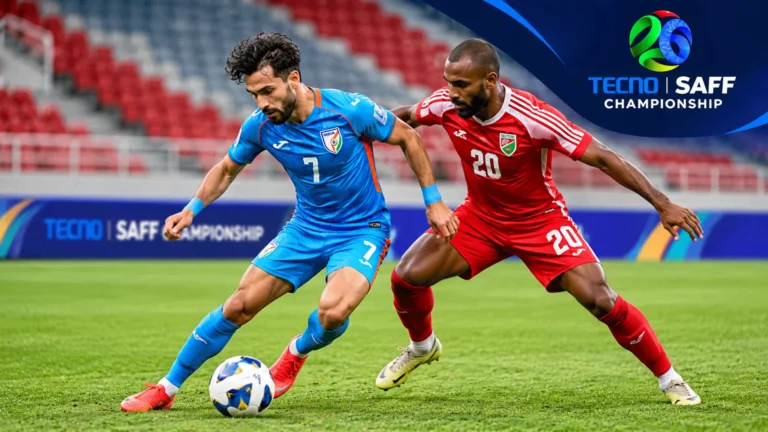
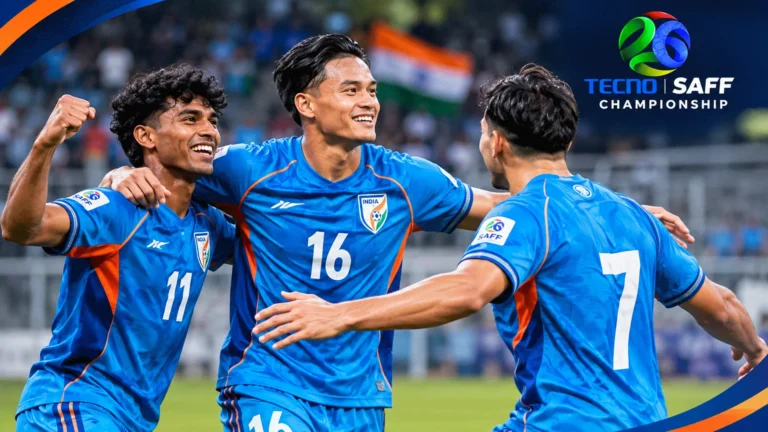
SAFF Championship: History, Past Winners and the Evolution of South Asian Football
From the inaugural SAARC Gold Cup in 1993 to India's ninth title in 2023, explore the complete SAFF Championship winners list, memorable finals, legendary players and the tournament's role in shaping South Asian football.

Football in South Asia has always been about more than ninety minutes on the pitch. It carries national pride, historic rivalries, passionate supporters and the ambitions of countries striving to establish themselves in Asian football. At the centre of this regional football story stands the SAFF Championship, the leading men’s international football tournament organised by the South Asian Football Federation.
Since its establishment in 1993, the competition has witnessed India’s remarkable dominance, Bangladesh’s historic home triumph, the Maldives’ rise as a competitive force, Afghanistan’s breakthrough and several unforgettable encounters between neighbouring nations. The tournament has also provided a platform for footballers who might otherwise receive limited international exposure.
As South Asian football prepares for another chapter in 2026, the SAFF Championship’s history offers an opportunity to understand how the region’s footballing landscape has evolved over more than three decades.
What Is the SAFF Championship?
The SAFF Championship is an international men’s football competition involving national teams from South Asia. It is organised by the South Asian Football Federation, the regional football body responsible for promoting cooperation and development among its member associations. The tournament has traditionally featured Bangladesh, Bhutan, India, Maldives, Nepal, Pakistan and Sri Lanka. Afghanistan also participated during its membership of SAFF before moving to the Central Asian Football Association in 2015.
Unlike the AFC Asian Cup, which brings together countries from across the Asian continent, the SAFF Championship focuses primarily on competition within South Asia. Its importance extends beyond determining a regional champion. For developing national teams, it offers competitive matches, international experience and opportunities to assess players against familiar but increasingly ambitious opponents. For supporters, it creates occasions when historic sporting rivalries take centre stage.
The Beginning: From SAARC Gold Cup to SAFF Championship
The competition began in 1993 as the South Asian Association for Regional Cooperation Gold Cup, commonly known as the SAARC Gold Cup. The inaugural tournament took place in Lahore, Pakistan, with four participating nations: India, Sri Lanka, Nepal and Pakistan. India emerged as the first champion, beginning an extraordinary record of success in the competition.
The early editions were relatively small affairs compared with major continental championships. However, they created a structured platform for regular football competition between South Asian national teams. The tournament’s name changed as its organisational identity developed.
In 1995, it was known as the South Asian Gold Cup. Later editions adopted the South Asian Football Federation Gold Cup identity before the competition became widely recognised as the SAFF Championship. The changes reflected the gradual development of the regional football structure. What began as a modest four-nation tournament eventually became one of South Asia’s most recognisable international football competitions.
Complete SAFF Championship Winners List: 1993–2023
The following table records all fourteen completed editions of the men’s SAFF Championship before the 2026 tournament.
| Year | Host Nation | Champion | Runner-up |
|---|---|---|---|
| 1993 | Pakistan | India | Sri Lanka |
| 1995 | Sri Lanka | Sri Lanka | India |
| 1997 | Nepal | India | Maldives |
| 1999 | India | India | Bangladesh |
| 2003 | Bangladesh | Bangladesh | Maldives |
| 2005 | Pakistan | India | Bangladesh |
| 2008 | Maldives & Sri Lanka | Maldives | India |
| 2009 | Bangladesh | India | Maldives |
| 2011 | India | India | Afghanistan |
| 2013 | Nepal | Afghanistan | India |
| 2015 | India | India | Afghanistan |
| 2018 | Bangladesh | Maldives | India |
| 2021 | Maldives | India | Nepal |
| 2023 | India | India | Kuwait |
Note: The inaugural 1993 championship was decided through league standings rather than a conventional final. Kuwait participated as an invited team in 2023. The winners list reveals the scale of India’s dominance. The Blue Tigers won nine of the first fourteen editions, while only four other nations managed to lift the trophy.
Which Country Has Won the Most SAFF Championships?
India is the most successful nation in SAFF Championship history. The Indian men’s national team won nine titles between 1993 and 2023.
SAFF Championship Titles by Country
| Country | Titles | Winning Years |
|---|---|---|
| India | 9 | 1993, 1997, 1999, 2005, 2009, 2011, 2015, 2021, 2023 |
| Maldives | 2 | 2008, 2018 |
| Bangladesh | 1 | 2003 |
| Sri Lanka | 1 | 1995 |
| Afghanistan | 1 | 2013 |
Total completed editions: 14
Nepal, Pakistan and Bhutan had not won the men’s senior championship through 2023. India’s record reflects its comparatively stronger domestic football structure, larger player pool and longer history of international competition. However, India’s success has not been uninterrupted. Sri Lanka, Bangladesh, Maldives and Afghanistan have all demonstrated that the regional championship can produce unexpected results.
India’s Dominance in SAFF Championship History
India’s relationship with the SAFF Championship began with the inaugural title in 1993. The national team subsequently established itself as the dominant force in South Asian football, winning championships across different generations of players and coaches. The late 1990s were particularly successful.
India won consecutive editions in 1997 and 1999, with players such as I. M. Vijayan and Bhaichung Bhutia becoming central figures in the national team’s attacking performances. The 1997 final against Maldives remains one of India’s most emphatic victories in the tournament. India won 5–1, with Vijayan scoring twice. The following edition saw India defeat Bangladesh 2–0 in the final. Another important period came between 2009 and 2015, when India won three of four editions.
During these years, Sunil Chhetri emerged as one of the defining personalities of Indian international football. His goals, leadership and consistency helped India remain competitive even as regional opponents improved. India’s dominance continued into the 2020s with championship victories in 2021 and 2023.
However, winning the SAFF Championship has not always translated into comparable success at the broader Asian level. This difference highlights one of the central challenges facing Indian football: maintaining regional leadership while developing the technical and tactical quality needed to compete against stronger Asian opponents.
Sri Lanka’s Historic Triumph in 1995
The 1995 SAFF Championship was one of the earliest major surprises in the competition’s history. Sri Lanka hosted the tournament in Colombo and entered with an opportunity to challenge India’s early dominance. The hosts reached the final against India, producing a closely contested encounter.
After ninety minutes without a goal, Sri Lanka secured victory through Sarath Wellage’s extra-time winner. The 1–0 result delivered Sri Lanka’s first SAFF Championship title. The achievement remains historically important because it demonstrated that the tournament was not destined to be controlled exclusively by India.
For Sri Lankan football, the victory became a landmark moment. It also illustrated how home support, disciplined organisation and effective tournament preparation could help a smaller football nation overcome a stronger opponent.
Bangladesh’s Unforgettable 2003 Championship
Bangladesh’s greatest achievement in SAFF Championship history came in 2003. Hosting the competition in Dhaka, Bangladesh produced a memorable campaign that captured the attention of football supporters across the country. The hosts defeated India 2–1 in the semi-finals before facing Maldives in the final. The championship match ended 1–1 after extra time.
Bangladesh subsequently won the penalty shootout 5–3, securing its first and, through 2023, only SAFF Championship title. The triumph represented a defining moment in Bangladeshi football. It demonstrated the potential of the country’s national team when supported by a passionate home crowd and a well-organised tournament campaign.
The 2003 success also remains an important reference point whenever Bangladesh approaches another SAFF Championship. Despite continued participation and several competitive performances, the national team has struggled to reproduce that championship-winning achievement. The return of the tournament to Bangladesh in 2026 therefore carries considerable historical significance.
Maldives: South Asia’s Most Successful Challenger to India
Although India has dominated the competition, Maldives has emerged as its most successful challenger. The island nation has won the SAFF Championship twice, in 2008 and 2018. Both victories came against India in the final.
Maldives’ First Championship in 2008
The 2008 edition was jointly hosted by Maldives and Sri Lanka. Maldives reached the final against India and secured a memorable 1–0 victory. Mukhtar Naseer’s late goal proved decisive. The triumph was particularly significant because it established Maldives as a genuine regional football power.
The Second Title in 2018
A decade later, Maldives repeated the achievement. The 2018 championship took place in Bangladesh, where Maldives defeated India 2–1 in the final. The result confirmed that the country’s earlier success had not been an isolated achievement.
For a nation with a relatively small population, Maldives’ two championships demonstrate the importance of strong football culture, competitive domestic development and effective national-team preparation.
Afghanistan’s Breakthrough in 2013
The 2013 SAFF Championship produced another significant moment in South Asian football history. Afghanistan defeated India 2–0 in the final in Kathmandu, Nepal, to win its first regional championship. The victory was especially meaningful for a country whose football development had faced considerable challenges. Afghanistan had previously finished runners-up to India in the 2011 final.
Two years later, the team reversed that result and claimed the trophy. Its success reflected improvements in player development, organisation and international experience. Afghanistan subsequently moved from SAFF to the Central Asian Football Association in 2015. Although the country no longer participates in the regional competition, its 2013 championship remains part of SAFF history.
The Rise of Nepal and Bhutan
Nepal and Bhutan have contributed significantly to the competitive identity of South Asian football, even without winning the senior men’s SAFF Championship through 2023.
Nepal’s greatest achievement came in 2021, when it reached the final for the first time. The team faced India in Maldives but suffered a 3–0 defeat. Nevertheless, reaching the final represented an important milestone for Nepali football. The achievement reflected the country’s ability to challenge established regional opponents.
Bhutan, meanwhile, has traditionally faced greater challenges in international competition. Its relatively small player pool and limited professional football infrastructure have made sustained success difficult. However, participation in regional tournaments provides valuable experience for Bhutanese footballers.
For both countries, the SAFF Championship remains an important opportunity to measure progress and develop competitive national teams.
The 2023 SAFF Championship: India’s Ninth Title
The 2023 SAFF Championship, held in Bengaluru, was one of the most memorable recent editions. For the first time, the competition included two invited teams from outside the South Asian Football Federation: Kuwait and Lebanon. Their participation increased the level of competition and created additional challenges for the traditional SAFF nations.
India, playing under head coach Igor Štimac, reached the semi-finals after a competitive group-stage campaign. The Blue Tigers defeated Lebanon in a penalty shootout to secure a place in the final. Kuwait awaited India in the championship match at the Sree Kanteerava Stadium. The final ended 1–1 after extra time. India subsequently won the penalty shootout 5–4 to claim a record ninth title.
Sunil Chhetri played an influential role throughout the competition, finishing as its leading goalscorer with five goals. The victory was celebrated by Indian supporters, but the tournament also offered a broader lesson. Facing teams such as Kuwait and Lebanon provided valuable competitive experience against opponents outside India’s usual regional football environment. That experience is important if Indian football is to progress beyond success within South Asia.
Legendary Players Who Shaped the SAFF Championship
Over three decades, several footballers have helped define the competition’s history.
Sunil Chhetri — India’s Modern Football Icon
Sunil Chhetri became one of the most influential players in SAFF Championship history. His goalscoring consistency, leadership and performances in important matches contributed to India’s success across multiple editions. Chhetri’s performances in the 2021 and 2023 tournaments were particularly important. He finished the 2023 competition with five goals and helped India win its ninth title. His contribution extended beyond goals, as his professionalism and competitive mentality influenced successive generations of Indian footballers.
Bhaichung Bhutia — A Defining Figure of Indian Football
Bhaichung Bhutia was central to India’s international football identity during the late 1990s and 2000s. His attacking ability and leadership helped India achieve success in regional competitions. Bhutia scored in important SAFF Championship matches, including the 1999 final against Bangladesh. His performances helped establish India as a consistent regional force.
I. M. Vijayan — India’s Attacking Maestro
I. M. Vijayan was one of India’s most technically gifted attacking players. His performances during the 1997 SAFF Championship were especially memorable. Vijayan scored twice in India’s 5–1 final victory against Maldives. His creativity and finishing ability made him one of the outstanding Indian footballers of his generation.
Ali Ashfaq — The Maldives Football Legend
Ali Ashfaq became one of the most recognisable names in Maldivian football. His goalscoring ability, movement and technical quality made him a major threat to regional opponents. Ashfaq shares the all-time SAFF Championship goalscoring record of 23 goals with Sunil Chhetri. He also scored ten goals during the 2013 tournament, a remarkable individual achievement. His career demonstrates that outstanding football talent can emerge from countries with relatively small populations.
Why the SAFF Championship Matters to South Asian Football
The SAFF Championship serves several important purposes within the region’s football ecosystem.
1. International Experience for Developing Teams
South Asian national teams often have limited opportunities to play regular competitive matches against opponents of similar strength. The championship helps address that problem. It allows coaches to evaluate players under tournament pressure and provides younger footballers with valuable international experience.
2. Regional Rivalries and Supporter Engagement
Matches between India and Pakistan, India and Bangladesh, or India and Maldives often attract attention beyond ordinary international fixtures. These encounters carry historical, cultural and sporting significance. Such rivalries can increase public interest in football, particularly in countries where cricket dominates the sporting landscape.
3. Opportunities for Emerging Footballers
The tournament can provide a platform for players from smaller football nations to demonstrate their abilities. Strong performances may attract attention from domestic clubs, international scouts and national-team selectors. This exposure is especially valuable in countries with limited professional football opportunities.
4. Development of National Football Programmes
Regional competition provides football associations with a benchmark for evaluating progress. Teams can assess tactical development, physical preparation, squad depth and their ability to perform under pressure. The lessons from SAFF competitions can help inform future coaching and development programmes.
The Major Challenges Facing South Asian Football
Despite its historical importance, South Asian football continues to face several structural challenges.
Limited Professional Football Infrastructure
Many countries in the region lack sufficient high-quality training grounds, stadiums and professional development facilities. Without consistent investment, talented players may struggle to reach their full potential.
Financial Constraints
National football associations and domestic clubs often operate with limited resources. Financial difficulties can affect youth development, coaching appointments, international exposure and the organisation of domestic competitions.
Irregular International Competition
Teams need regular competitive matches to improve. Long gaps between tournaments and limited opportunities against stronger international opponents can slow development. The SAFF Championship is valuable, but it cannot replace a comprehensive international calendar.
Youth Development and Coaching Standards
A sustainable football system requires effective scouting, qualified coaches, competitive youth leagues and clear pathways to senior football. Several South Asian countries continue to face difficulties establishing these structures consistently.
The Gap Between Regional and Continental Standards
Success in the SAFF Championship does not automatically indicate readiness to compete with Asia’s strongest national teams. Countries such as Japan, South Korea, Iran, Saudi Arabia and Australia operate within considerably more developed competitive environments. For South Asian nations, the challenge is to translate regional experience into better performances in AFC and FIFA competitions.
SAFF Championship and the Future of South Asian Football
The future importance of the SAFF Championship will depend on how effectively regional football authorities use the competition as part of a broader development strategy. Simply organising a tournament every few years is not enough. The region needs stronger domestic leagues, better youth development systems, improved coaching education and more consistent international exposure.
The championship can become more valuable when supported by year-round development programmes. Greater investment in women’s football, age-group competitions and grassroots participation can also strengthen the region’s overall football ecosystem.
For India, the objective must be to move beyond regional dominance and compete more effectively at the continental level.
For countries such as Bangladesh, Nepal, Maldives, Bhutan, Pakistan and Sri Lanka, the tournament offers an opportunity to demonstrate progress and challenge established opponents. A more competitive South Asian football environment would ultimately benefit every participating nation.
SAFF Championship 2026: A New Chapter Begins in Bangladesh
The fifteenth edition of the men’s SAFF Championship is scheduled to begin on 5 November 2026 at the National Stadium in Dhaka, Bangladesh, with the final scheduled for 17 November. Six nations are participating: Bangladesh, Bhutan, Sri Lanka, India, Maldives and Pakistan.
India enter the competition as defending champions after winning the previous edition in 2023. The tournament also carries particular importance for hosts Bangladesh, whose only championship victory came in 2003.
For India, the objective is a record-extending tenth title. For the other participating teams, the championship presents an opportunity to challenge India’s dominance and establish a new chapter in regional football history. The outcome will depend not only on individual talent but also on preparation, tactical organisation and the ability to perform consistently under pressure.
Editorial update: 5 November 2026. This section describes the tournament before the opening matches and does not include subsequent results.
Conclusion: More Than a Regional Football Tournament
The SAFF Championship has played an important role in South Asian football since its establishment in 1993. From India’s inaugural victory to Sri Lanka’s historic triumph, Bangladesh’s unforgettable 2003 championship, Maldives’ two titles and Afghanistan’s 2013 breakthrough, the competition has produced moments that remain part of the region’s sporting history.
India’s nine championships underline its long-standing regional dominance. However, the tournament’s greater significance lies in the opportunities it provides to developing football nations. South Asian football still faces substantial challenges involving infrastructure, finance, youth development and international competitiveness.
The SAFF Championship alone cannot solve these problems, but it remains an important platform for progress. As the 2026 edition begins in Bangladesh, the central question is not simply which country will lift the trophy. It is whether South Asian football can use its regional competition to build a stronger future on the wider Asian stage.
Frequently Asked Questions (FAQ)
When was the first SAFF Championship held?
The first SAFF Championship was held in 1993 in Lahore, Pakistan. It was originally known as the SAARC Gold Cup, and India won the inaugural tournament.
Which country has won the most SAFF Championships?
India is the most successful nation, winning nine titles between 1993 and 2023.
How many times has Bangladesh won the SAFF Championship?
Bangladesh won the men’s SAFF Championship once, in 2003, defeating Maldives in a penalty shootout in the final.
Which countries have won the SAFF Championship?
Through 2023, five countries had won the tournament: India, Maldives, Bangladesh, Sri Lanka and Afghanistan.
Who won the SAFF Championship in 2023?
India won the 2023 SAFF Championship by defeating Kuwait 5–4 in a penalty shootout after the final ended 1–1 following extra time.
Who are the all-time leading goalscorers in SAFF Championship history?
India’s Sunil Chhetri and Maldives’ Ali Ashfaq share the record with 23 goals each.
Where is the SAFF Championship 2026 being held?
The 2026 men’s SAFF Championship is being held in Dhaka, Bangladesh, from 5 to 17 November, according to the latest published tournament schedule.
Related Stories